Where Are You Investing Your Energy?
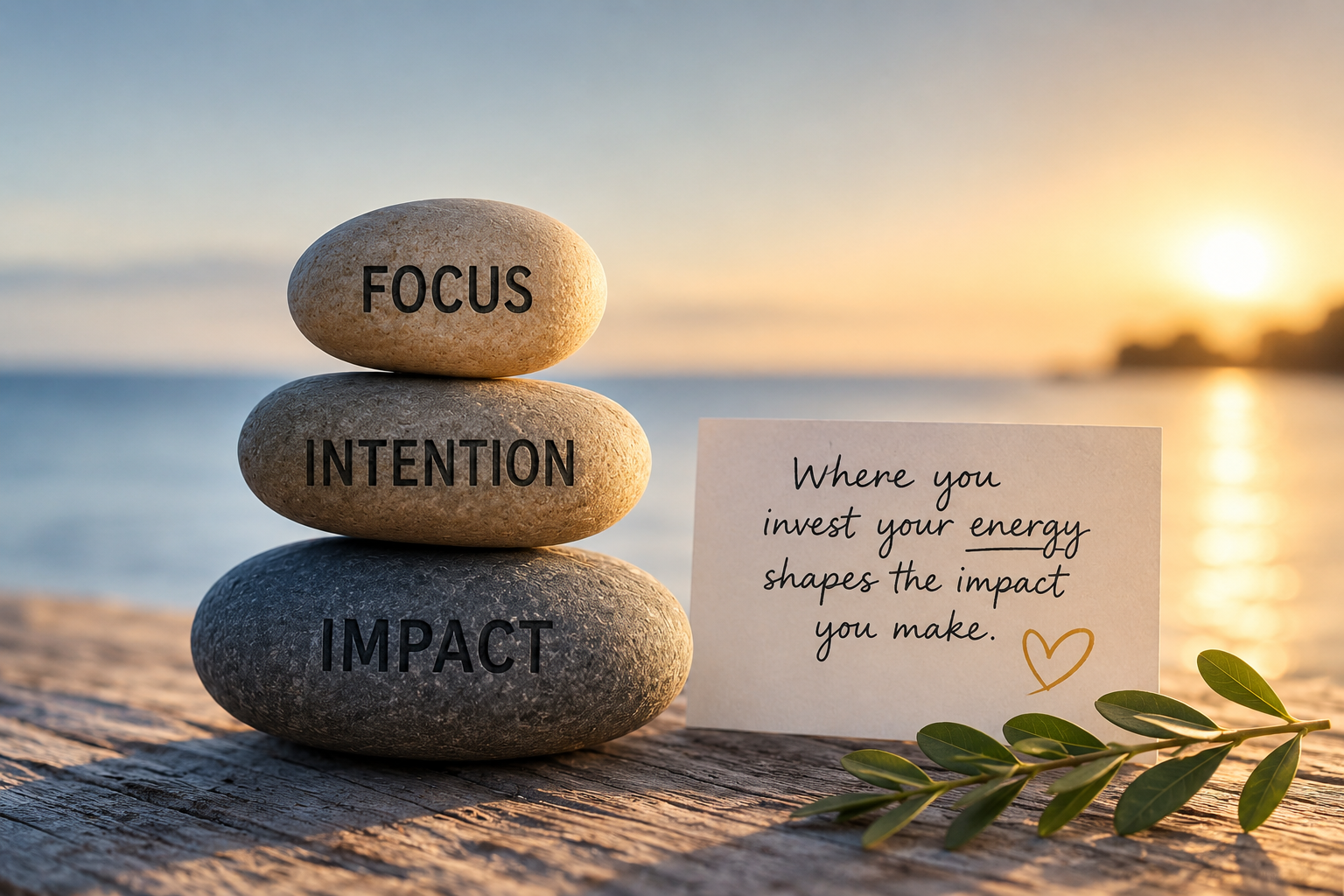
In recent articles, and as I have immersed myself once again in my research, I have found myself reflecting on role clarity and purpose. The more I have explored these ideas, the more I have realised they all point towards another important question—what does it really mean to work with intention?
As I have reflected on both my experiences working across three schools and my research, I have come to believe that the answer begins with understanding where we choose to invest our time, energy, and attention.
Where should we focus our energy each day?
It is a simple question, yet the answer shapes how we lead, how we build relationships, and ultimately, the difference we make.
Like many Executive Assistants working in education, I care deeply about my profession, my school community, and the people within it. I care about my colleagues, the future of our students, the challenges we face, and the decisions that shape our community. It is only natural to become emotionally invested in the work we do because, for many of us, it is far more than just a job.
But I have come to realise that while we may care deeply about many things, effective leadership is not about trying to be everywhere or solve every problem. It is about intentionally investing our time, energy, and attention where we can have the greatest positive influence.
Stephen Covey, in The 7 Habits of Highly Effective People, describes this through two simple but powerful ideas: our Circle of Concern and our Circle of Influence. Our Circle of Concern contains everything we think about and care about, yet have little or no control over. Organisational change, other departments, people's behaviour, unexpected challenges, and decisions made beyond our role all sit within this space.
Our Circle of Influence, however, is different. It is where our actions, decisions, relationships, attitudes, and behaviours can genuinely make a difference.
Our Circle of Influence does not need to be large to be significant.
As Executive Assistants, our greatest influence is often found in the relationships closest to us - our Senior Executive, our leadership team, and the colleagues we work alongside each day. By investing intentionally in these relationships, we create a ripple effect that extends far beyond our immediate circle, ultimately strengthening collaboration, supporting organisational and strategic goals, and benefiting the entire school community.
As I reflected on Covey's model, I found myself asking, What does my own Circle of Influence look like?
For me, it begins with the people I work most closely with each day - my Senior Executive, our College Executive and Leadership Teams, and my own team. These are the relationships where I have the greatest opportunity to build trust, communicate effectively, contribute to positive outcomes, and make a meaningful difference. By investing my energy in these relationships, I can support those around me professionally while contributing to the school's organisational and strategic goals.
One of the things I have come to appreciate over time is that our Circle of Influence is not fixed. As we move from one workplace to another throughout our careers, the people within that circle naturally change. Each new role presents fresh opportunities to build trust, develop meaningful relationships, and create positive influence. While the people around us may change, the opportunity to invest our energy where we can make the greatest difference remains the same.
Covey suggests that proactive people intentionally invest their time and energy within their Circle of Influence. Rather than becoming consumed by circumstances they cannot change, they avoid dwelling in their Circle of Concern and instead focus on what they can influence. In doing so, they strengthen their capacity to lead, contribute, and create meaningful impact.
This idea has challenged me to ask a different question.
Not, What am I concerned about?
But rather,
Where can I have the greatest positive influence today?
As Executive Assistants, our work naturally places us close to complexity. We often have visibility across multiple teams, competing priorities, and the many moving parts of a school. It can be tempting to become consumed by everything happening around us.
Yet the greatest impact rarely comes from worrying about what we cannot control.
It comes from investing our energy where it matters most.
For me, this might mean strengthening a relationship, anticipating a challenge before it becomes a problem, communicating with clarity, creating calm during busy periods, or supporting my Senior Executive and team to make well-informed decisions. These actions may seem small in isolation, but collectively they strengthen my ability to positively influence the people, school culture, and environment around me.
One of the greatest lessons I continue to learn is that where we place our attention matters. It is natural to compare ourselves with others, particularly in today's world where success is often measured against external benchmarks. Yet comparison rarely strengthens our leadership; more often, it distracts us from the work that is ours to do. Leadership is not about keeping pace with someone else's journey. It is about remaining focused on our own purpose, growth, and the contribution we are uniquely positioned to make.
There is another circle that I often return to when reflecting on leadership - Simon Sinek's Circle of Safety. While Covey asks us to consider where we invest our time and energy, Sinek challenges us to think about how we create an environment where people feel safe, trusted, and able to do their best work.
Sinek argues that remarkable organisations are built when people feel psychologically safe, trusted, and that they belong. While technical skills and professional competence are important, they are not what create truly high-performing partnerships. Trust, loyalty, empathy, and open communication are the foundations that allow people to do their best work together.
For Executive Assistants and Senior Executives, this partnership has the potential to create that Circle of Safety - not only for each other, but for the wider school community.
When people feel supported, valued, and trusted, collaboration flourishes. Leaders make better decisions. Teams work more effectively. Culture becomes stronger.
Perhaps this is where these two circles intersect.
By intentionally focusing on our own Circle of Influence, we help create a Circle of Safety for those around us.
We may not be able to influence every decision, solve every problem, or remove every challenge. But we can influence the experience others have of working alongside us.
We can choose to build trust. We can choose to communicate with care. We can choose to bring calm rather than chaos. We can choose to encourage rather than criticise.
These choices may seem small in isolation, but over time they shape the culture of our schools in profound ways.
As Executive Assistants in education, our work ultimately extends beyond supporting a Senior Executive. Every conversation we have, every relationship we build, every decision we influence contributes to something much larger than ourselves - the experience of our colleagues, the culture of our schools, and ultimately, the outcomes for the young people entrusted to our care.
That is why where we choose to invest our energy matters.
As I continue on my own leadership journey, I am increasingly convinced that influence is not something we are given. It is something we cultivate, one interaction, one decision, and one relationship at a time.
Perhaps our influence has less to do with the position we hold and more to do with the choices we make each day.
So, I leave you with one question.
Where are you investing your energy?
Is it in your Circle of Concern...
Or in your Circle of Influence?